Word Count Guide: Pages, Reading Time and More
Everything writers need to know about word count — from pages and reading time to social media limits, readability scores, and keyword density.
Every word count tool on the internet assumes you read at 300 words per minute. Most people believe this too. But that number is wrong.
In 2019, Professor Marc Brysbaert published a meta-analysis of 190 reading speed studies covering 18,573 participants. The result was striking — the average adult silent reading speed for non-fiction text is 238 words per minute. That is 20% lower than the commonly cited 300 WPM figure. In practical terms, most reading time estimates you see online are shorter than reality.
This is not a trivial difference. A 2,000-word blog post takes 6 minutes 40 seconds at 300 WPM but 8 minutes 24 seconds at 238 WPM. That is nearly two extra minutes. If you tell your readers "5 min read" and it actually takes 8 minutes, you are breaking a promise before they even start.
Word count is more than a number. It determines whether your essay passes, whether your tweet can be posted, where your blog ranks in search results, and how long your presentation will take. This guide covers everything about word count — words per page, standards by content type, social media character limits, reading and speaking time calculations, readability scores, and keyword density — all in one place.
How Many Words Fit on a Page?
This is one of the most searched word count questions, especially among students. "How many pages is 1,000 words?" — the answer depends entirely on your font, size, and line spacing.
Here are the standard figures for 12-point font on A4 paper with 1-inch margins:
| Font | Single-Spaced | Double-Spaced |
|---|---|---|
| Times New Roman (12pt) | 500–550 words | 250–300 words |
| Arial (12pt) | 450–500 words | 225–275 words |
| Calibri (11pt) | 550–600 words | 275–300 words |
Using these figures, you can estimate page counts for any word count target:
| Word Count | Single-Spaced | Double-Spaced |
|---|---|---|
| 250 | ~0.5 pages | ~1 page |
| 500 | ~1 page | ~2 pages |
| 1,000 | ~2 pages | ~4 pages |
| 1,500 | ~3 pages | ~6 pages |
| 2,000 | ~4 pages | ~8 pages |
| 2,500 | ~5 pages | ~10 pages |
| 5,000 | ~10 pages | ~20 pages |
Keep in mind that these figures are for body text only. Titles, headings, reference lists, tables, and images all add to the actual page count. Also, Google Docs, Microsoft Word, and LaTeX each have slightly different default margins and line heights, so when exact page count matters, always check in your final format.
Word Count Standards for Every Type of Writing
The right word count depends entirely on what you are writing. Here are the standards for nearly every type of text, from academic essays to novels.
Academic Writing
| Type | Word Count |
|---|---|
| High school essay | 500–1,500 |
| Undergraduate essay (freshman/sophomore) | 1,000–1,500 |
| Undergraduate essay (junior/senior) | 2,000–3,500 |
| Undergraduate thesis | 8,000–15,000 |
| Master's thesis | 15,000–50,000 |
| Doctoral dissertation | 50,000–80,000 |
| Common App essay (US college admission) | 250–650 (sweet spot: 500–650) |
| IELTS Task 2 | 250+ (ideal: 270–320) |
| TOEFL Independent Writing | 300–400 |
Word count requirements vary enormously by discipline. A chemistry doctoral dissertation might be around 40,000 words, while a philosophy dissertation can reach 100,000. Many American universities cap dissertations at 100,000 words and require special permission to exceed that limit.
Professional and Business Writing
| Type | Optimal Length | Evidence |
|---|---|---|
| 50–125 words | Boomerang: response rates above 50% in this range (40M emails analyzed) | |
| Resume | 475–600 words | ResumeGo: 8.2% interview rate, nearly double average (7,712 resumes studied) |
| Cover letter | 250–400 words | Always one page; entry-level may be shorter |
| Newsletter | ~200 words | Optimized for click-through rate |
The email data is particularly striking. Boomerang's analysis of 40 million emails found that emails in the 50-to-125-word range consistently achieved the highest response rates — above 50%. Once an email exceeds 500 words, the response rate drops to 44%. Shorter is better.
For resumes, ResumeGo's study of 7,712 resumes found that the 475-to-600-word range produced an 8.2% interview rate — nearly double the average. Recruiters were also 2.3 times more likely overall to prefer a two-page resume over a one-page version, with the preference rising to 2.9 times for managerial positions.
SEO and Content Marketing
| Type | Recommended Length |
|---|---|
| Blog post (competitive SEO keywords) | 1,500–2,500 words |
| Quick-answer post | 300–500 words |
| How-to guide | 1,800+ words |
| Pillar/ultimate guide | 3,000–5,000 words |
HubSpot's research found that the ideal blog post length for SEO is 2,100 to 2,400 words, based on their own top-performing content. Backlinko and BuzzSumo's analysis of 912 million blog posts confirmed this pattern: content over 3,000 words receives 77.2% more referring domain links than content under 1,000 words.
But longer is not always better. Content over 10,000 words can actually hurt rankings if it fails to match search intent. The key is writing as much as the topic demands — no more, no less — while delivering maximum value within that length.
Fiction: Novel Word Counts by Genre
| Genre | Word Count |
|---|---|
| Picture book | 500–1,000 |
| Early reader | 2,000–5,000 |
| Chapter book | 5,000–15,000 |
| Middle grade | 25,000–40,000 |
| Young adult (YA) | 50,000–80,000 |
| Literary fiction (debut) | 80,000–95,000 |
| Thriller / Mystery | 70,000–90,000 |
| Science fiction / Fantasy | 90,000–120,000 |
| Romance | 70,000–90,000 |
Science fiction and fantasy novels tend to be the longest because worldbuilding requires additional space. However, for debut authors, agents and publishers generally prefer manuscripts under 100,000 words — printing costs and market risk are lower.
Social Media Character Limits (2026)
When writing for social media, you need to know two things: the maximum character limit and the truncation point. Even if your post is under the maximum, content beyond the truncation point is hidden behind a "See more" button. This directly affects engagement — if your key message and call-to-action appear after the fold, most users will never see them.
| Platform | Maximum | Truncation Point | Bio Limit |
|---|---|---|---|
| Twitter / X (free) | 280 chars | Full display | 160 chars |
| Twitter / X (Premium) | 25,000 chars | ~280 chars | 160 chars |
| Instagram caption | 2,200 chars | ~125 chars | 150 chars |
| 63,206 chars | ~477 chars | 101 chars | |
| 3,000 chars | ~210 chars | 2,600 chars | |
| TikTok caption | 4,000 chars | Varies | 80 chars |
| YouTube title | 100 chars | ~70 chars | — |
| YouTube description | 5,000 chars | ~150 chars | — |
| Threads | 500 chars | Full display | — |
| SMS (GSM-7) | 160 chars/segment | — | — |
Consider Instagram: the maximum caption length is 2,200 characters, but users only see the first 125 characters before they have to tap "more." If you do not hook readers within those 125 characters, the remaining 2,075 characters might as well not exist. This is why social media professionals always place the most important message and call-to-action before the truncation point.
SEO Character Limits
| Element | Recommended Length |
|---|---|
| Google title tag | 50–60 characters |
| Meta description | 120–155 characters |
| Email subject line | 30–50 characters (4–7 words) |
Google does not penalize longer meta descriptions, but it will truncate or rewrite them. The safe range is 120 to 155 characters.
Advertising Character Limits
| Element | Limit |
|---|---|
| Google Responsive Search Ad — headline | 30 chars (up to 15 headlines) |
| Google Responsive Search Ad — description | 90 chars (up to 4 descriptions) |
| Facebook/Meta primary text | ~125 chars visible |
| Facebook headline | ~27–40 chars |
How Long Does It Take to Read or Speak Your Words?
Reading Time
The key to accurate reading time estimates is using the right WPM value. Based on Brysbaert's 2019 meta-analysis:
- Silent reading (non-fiction): 238 WPM
- Silent reading (fiction): 260 WPM
- Reading aloud: 183 WPM
The formula is simple: Reading time (minutes) = word count ÷ 238
| Word Count | Actual Time (238 WPM) | Common Overestimate (300 WPM) |
|---|---|---|
| 500 | 2 min 6 sec | 1 min 40 sec |
| 1,000 | 4 min 12 sec | 3 min 20 sec |
| 1,500 | 6 min 18 sec | 5 min 0 sec |
| 2,000 | 8 min 24 sec | 6 min 40 sec |
| 3,000 | 12 min 36 sec | 10 min 0 sec |
| 5,000 | 21 min 0 sec | 16 min 40 sec |
The difference is not trivial. At 5,000 words, the gap between the real speed and the commonly used estimate is 4 minutes and 20 seconds.
One more thing: reading on screens is different from reading on paper. A 2018 meta-analysis by Kong, Seo, and Zhai found that paper outperforms screens for comprehension by about a fifth of a standard deviation. People tend to read faster on screens but understand less — and they overestimate how well they understood. This effect is most pronounced for non-fiction texts longer than 500 words.
Speaking Time
For presentations and speeches, you need a different WPM value:
- Comfortable presentation pace: 130–160 WPM
- TED Talk speakers (average): 150–173 WPM
- Conversational speech: 130–160 WPM
- Audiobook narration: 150–160 WPM
The formula: Speaking time (minutes) = word count ÷ 130 (for a relaxed pace)
| Speech Type | Duration | Word Count |
|---|---|---|
| Wedding toast (brief) | 1–2 min | 150–300 |
| Best man / maid of honor speech | 3–5 min | 400–700 |
| Short business presentation | 5 min | 650–800 |
| Conference talk | 10 min | 1,000–1,600 |
| TED Talk (maximum) | 18 min | ~2,500 |
Readability Scores Explained
A readability score measures how easy your text is to understand. The two most widely used metrics are the Flesch Reading Ease and the Flesch-Kincaid Grade Level.
Flesch Reading Ease
Score = 206.835 − 1.015 × (words / sentences) − 84.6 × (syllables / words)
Higher scores mean easier reading:
| Score | Difficulty | Grade Level |
|---|---|---|
| 90–100 | Very Easy | 5th grade |
| 80–89 | Easy | 6th grade |
| 70–79 | Fairly Easy | 7th grade |
| 60–69 | Standard | 8th–9th grade |
| 50–59 | Fairly Difficult | 10th–12th grade |
| 30–49 | Difficult | College level |
| 0–29 | Very Difficult | College graduate |
Flesch-Kincaid Grade Level
Grade = 0.39 × (words / sentences) + 11.8 × (syllables / words) − 15.59
The result corresponds to a US school grade level. A score of 8.0 means an eighth-grader can understand the text. The two Flesch metrics are roughly inverse — a high Reading Ease score corresponds to a low Grade Level.
What Major Publications Score
| Publication | Flesch Reading Ease | Approximate Grade Level |
|---|---|---|
| Reader's Digest | ~65 | 8–9 |
| Time Magazine | ~52 | ~10 |
| New York Times | — | ~10 |
| Harvard Law Review | ~30 | ~14+ |
Notice that Reader's Digest — one of the most widely read magazines in America — writes at a Grade 8–9 level. Harvard Law Review writes at Grade 14+, essentially requiring a graduate education. If you want to reach the widest possible audience, aim for Grade 7 to 9.
This is not just a suggestion. The WCAG (Web Content Accessibility Guidelines) Level AAA Success Criterion 3.1.5 states that when text exceeds a lower secondary education reading level (roughly Grade 8–9), supplemental content or a simplified version should be available.
Practical Tips to Improve Readability
If your readability score is low (meaning the text is too difficult), these adjustments help:
- Shorten your sentences. Average sentence length above 20 words hurts readability. Aim for 15 to 20 words per sentence.
- Choose simpler words. "Use" instead of "utilize," "then" instead of "subsequently," "about" instead of "approximately."
- Use active voice. "The team wrote the report" instead of "The report was written by the team."
- One idea per paragraph. If a paragraph exceeds four sentences, consider splitting it.
- Use bullet lists. Itemized information is easier to scan than prose.
What Is Keyword Density?
Keyword density is the percentage of times a specific word or phrase appears in your text relative to the total word count.
Keyword Density = (keyword count / total words) × 100
For example, if "word count" appears 30 times in a 2,000-word article, the keyword density is 1.5%.
In the early 2010s, keyword density was a critical SEO factor. Repeating a target keyword at 2–3% density could boost search rankings. But as Google's algorithms have evolved, natural language and search intent matching now matter far more than hitting a specific density percentage.
That said, keyword density is not irrelevant. Some practical guidelines still hold:
- 1–2% is the natural range. When you write naturally about a topic, your keyword density typically falls in this range without any effort.
- Above 3% is a red flag. Google may interpret this as keyword stuffing, which can hurt rankings.
- Use synonyms and related terms. Instead of repeating "word count" twenty times, mix in "word counting," "number of words," and "character count." This reads naturally and helps with semantic search.
Checking keyword density is still useful — it helps you catch unintentional overuse of the same term. But distorting your writing to hit a target density is counterproductive.
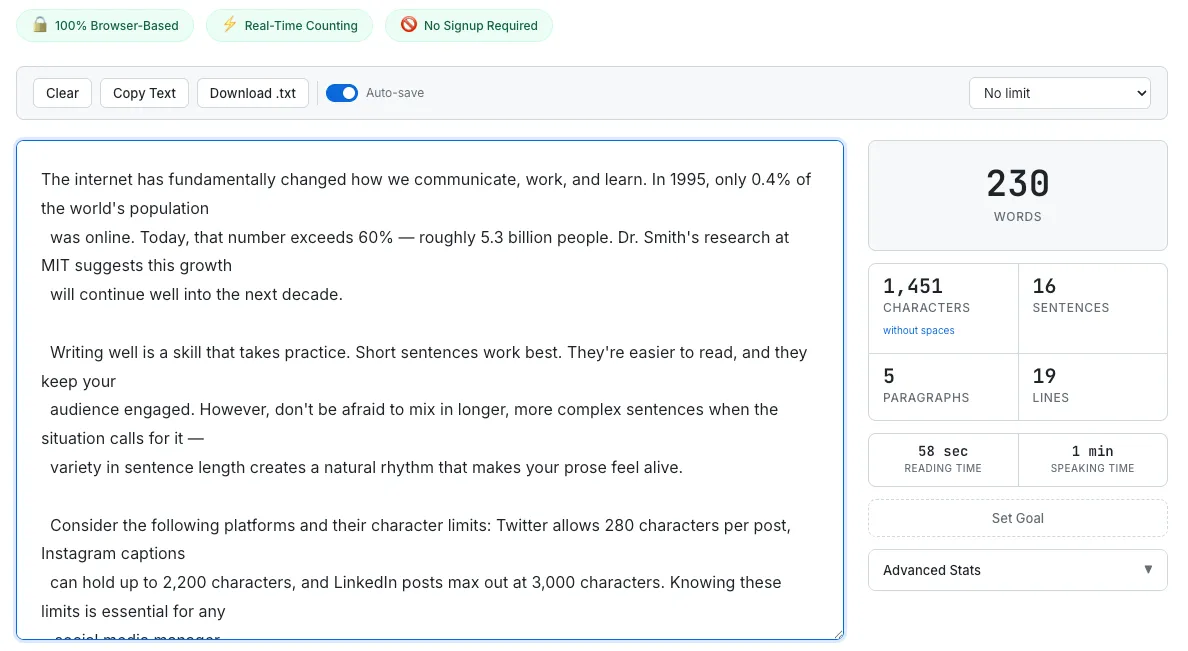
SudoTool's Word Counter shows all the metrics discussed in this guide — word count, character count, readability, keyword density, and reading time — in real time as you type.
Frequently Asked Questions
How many words is a 5-minute speech?
At a comfortable presentation pace of 130 WPM, a 5-minute speech is approximately 650 words. At a faster pace of 150 WPM, it is about 750 words. If you are new to public speaking, prepare around 700 words and time yourself during rehearsal — nerves tend to make you speak faster than planned.
How many words should a blog post be?
For competitive SEO keywords, 1,500 to 2,500 words is the optimal range. HubSpot research shows 2,100 to 2,400 words performs best for search rankings. For simple question-and-answer posts, 300 to 500 words is sufficient. The key is not length itself but how well you answer the reader's search intent.
How long does it take to read 1,000 words?
Based on the Brysbaert meta-analysis (2019), the average adult reads non-fiction at 238 WPM. So 1,000 words takes about 4 minutes and 12 seconds. Fiction is slightly faster at 260 WPM. On screens, people read faster but comprehend less compared to reading on paper.
What is a good Flesch Reading Ease score?
For a general audience, aim for 60 to 70 (Grade 8–9 level). Reader's Digest scores around 65. For academic or professional writing, lower scores are acceptable, but for web content, the WCAG AAA guideline recommends not exceeding a lower secondary education reading level — roughly Grade 8 to 9.
What is a good keyword density percentage?
Natural writing typically produces a 1 to 2% density without deliberate effort. Above 3% risks being flagged as keyword stuffing by search engines. In modern SEO, comprehensive topic coverage and natural language matter more than hitting a specific density number.
How long should a resume be?
ResumeGo's study of 7,712 resumes found that 475 to 600 words produced the highest interview rate at 8.2% — nearly double the average. Recruiters were 2.3 times more likely to prefer two-page resumes overall, with the preference rising to 2.9 times for managerial positions.
Is reading on a screen different from reading on paper?
Yes. A 2018 meta-analysis by Kong, Seo, and Zhai found that comprehension on paper is about a fifth of a standard deviation better than on screens. People read faster on screens but understand less, and they tend to overestimate their own comprehension. This effect is most pronounced for non-fiction texts longer than 500 words.
You can check all the metrics discussed in this guide — word count, character count, readability scores, keyword density, and reading time — using SudoTool's Word Counter. Read the story behind this tool: Why I Built a Word Counter When Every Browser Has One.