Readability Scores Explained: How to Write Content Anyone Can Understand
Readability formulas have guided writers for over 75 years. Understanding how they work — and what they actually measure — is the first step to writing text that reaches every reader, not just the ones with advanced degrees.
According to a Gallup analysis of PIAAC data from the U.S. Department of Education, 54% of U.S. adults lack proficiency in literacy. Over 43 million U.S. adults score at Level 1 or below on the PIAAC literacy scale — roughly equivalent to understanding only short, simple texts. If you have never checked your readability score, there is a good chance your writing is harder to read than you think.
I learned this the hard way. A landing page I wrote had a Flesch-Kincaid Grade Level of 14.2 — basically college-level prose. It read beautifully to me. It also had a 68% bounce rate. When I rewrote it at a 7th-grade reading level, conversions doubled. Same product, same audience, same price point. The only thing that changed was how easy the words were to read.
This guide will teach you everything you need to know about readability scores: what they measure, how 7 major formulas work, what grade level to target for your specific use case, and practical techniques to simplify your writing without dumbing it down. Whether you are a marketer optimizing landing pages, a healthcare writer making patient materials accessible, or a developer building content tools, you will leave here knowing how to put readability data to work.
Why Your Readability Score Matters More Than You Think
A readability score is not about making text "easy" in a condescending sense. It is about removing friction between your message and the person trying to understand it. The research on this is overwhelming, and it touches every field from marketing to medicine.
Bounce rates and scanning behavior
In 1997, Jakob Nielsen's landmark web usability study found that 79% of users scan web pages rather than reading word by word. That number has only grown as attention spans shortened and mobile screens replaced desktops. If your text is dense and complex, scanners will not even attempt to parse it — they will bounce.
Conversion rates
Data from Unbounce's Conversion Benchmark Report shows that landing pages written at a 5th–7th grade reading level convert at roughly twice the rate of those written at a college level. The mechanism is simple: when readers understand what you are offering without effort, they are more likely to take action. Complexity does not signal quality — it signals friction.
SEO impact
Google does not use readability scores as a direct ranking factor. But readability influences user behavior signals that Google absolutely does track: time on page, bounce rate, pogo-sticking (clicking a result, bouncing back, and clicking another). If your content is hard to read, users leave. When users leave, your rankings suffer. Readability is an indirect but powerful SEO lever.
Health literacy
This is where readability becomes genuinely life-or-death. According to the National Assessment of Adult Literacy (NAAL), only 12% of U.S. adults have proficient health literacy. The American Medical Association (AMA) has recommended for decades that patient materials be written at or below a 6th-grade reading level. Yet a 2021 study in the Journal of Patient Experience found that only 2.1% of 2,585 patient education materials actually met this standard. The gap between recommendation and reality is staggering — and patients pay the price with misunderstood diagnoses, skipped medications, and worse health outcomes.
What Are Readability Scores?
A readability score is a number produced by a mathematical formula that estimates how difficult a piece of text is to read. Most formulas work by measuring two core variables: sentence length (longer sentences are harder) and word complexity (longer words, multisyllabic words, or uncommon words are harder). The formula combines these inputs into a single output — either a score on a numerical scale (like Flesch Reading Ease's 0–100) or a U.S. grade level (like Flesch-Kincaid's "Grade 8" meaning an 8th grader could understand it).
The concept is older than you might expect. The first readability formulas appeared in the 1920s and 1930s, driven by educators who wanted objective ways to match textbooks to students' reading abilities. By the 1940s, readability research had exploded, and the formulas we still use today — Flesch, Dale-Chall — were published in that era. Military, government, healthcare, insurance, and legal industries have since adopted readability standards, and several U.S. states have passed laws requiring minimum readability scores for consumer-facing documents.
Today, seven formulas dominate the landscape. Each was born from a different era and a different need, but they all attempt to answer the same fundamental question: how hard is this text to read?
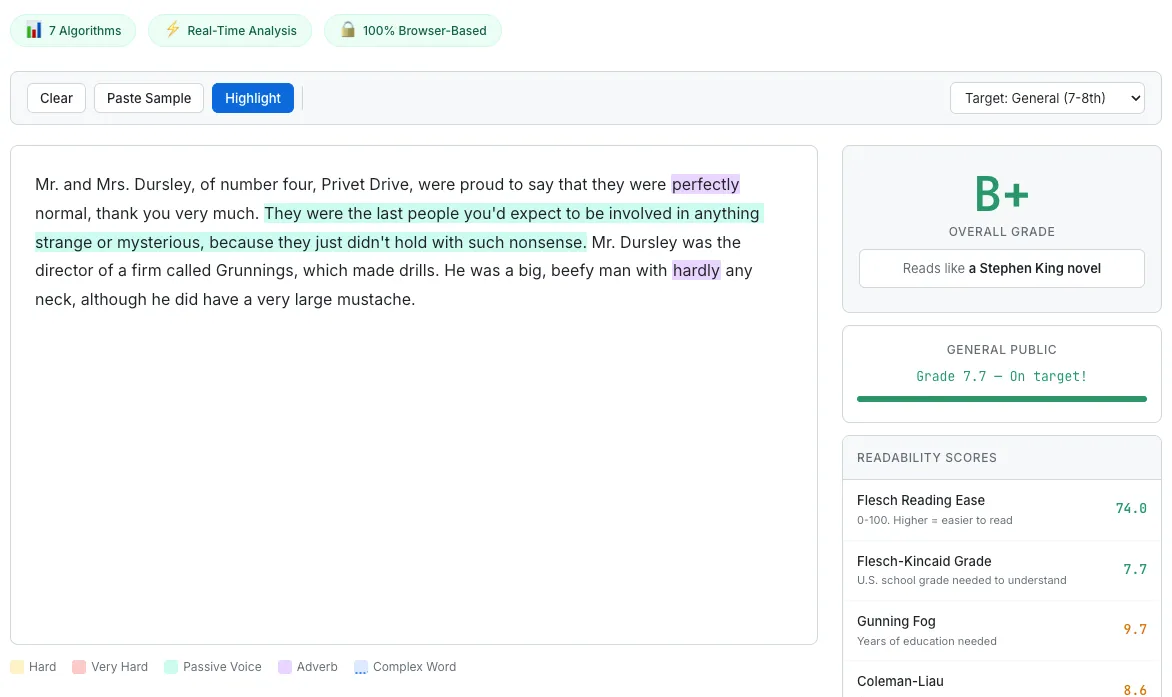
SudoTool's Readability Score Checker analyzing a Harry Potter excerpt — seven scores calculated instantly, with hard sentences highlighted in yellow.
7 Readability Formulas Explained in Depth
Each formula below has its own history, its own math, and its own best use case. Understanding the differences helps you choose the right tool for the job — and understand why different formulas sometimes give you different grades for the same text.
1. Flesch Reading Ease (1948)
Creator: Rudolf Flesch, an Austrian-born readability consultant who later worked with the Associated Press.
206.835 − 1.015 × (words / sentences) − 84.6 × (syllables / words)
Scale: 0–100, where higher is easier. A score of 60–70 is considered "standard" — roughly 8th–9th grade level. Scores above 80 are easy enough for a 6th grader. Below 30 is college-graduate level.
Why it matters: This is the most widely cited readability formula in the world. The state of Connecticut legally requires insurance policies to score at least 45 on the Flesch scale. Florida requires a score of 45 or higher for all insurance contracts. It is the formula most non-specialists think of when they hear "readability score."
Best for: General-purpose readability checking. A good starting point for any content.
2. Flesch-Kincaid Grade Level (1975)
Creators: Rudolf Flesch and J. Peter Kincaid, developed under contract for the U.S. Navy.
0.39 × (words / sentences) + 11.8 × (syllables / words) − 15.59
Scale: U.S. grade level. A score of 8.0 means an 8th grader should be able to understand the text.
Why it matters: In 1978, the U.S. Department of Defense adopted this formula as the standard for all military technical manuals and training documents (MIL-M-38784). Every military manual, from weapons maintenance to first aid, must meet Flesch-Kincaid standards. This is also the readability formula built into Microsoft Word.
Best for: When you need a quick grade-level estimate. Widely understood and universally supported.
3. Gunning Fog Index (1952)
Creator: Robert Gunning, an American businessman and textbook publisher who believed that unclear writing was like "fog" obscuring meaning.
0.4 × ((words / sentences) + 100 × (complex words / words))
Scale: U.S. grade level. A Fog Index of 12 means the text requires a 12th-grade (high school senior) reading level.
Why it matters: Gunning focused specifically on "complex words" — words with three or more syllables (excluding common suffixes like -ed, -es, -ing, and proper nouns). His insight was that multisyllabic words create the most friction for readers. The Fog Index became particularly popular in the business and journalism worlds.
Best for: Business writing, corporate communications, and journalism. Good at catching unnecessarily inflated vocabulary.
4. SMOG Index (1969)
Creator: G. Harry McLaughlin. SMOG stands for "Simple Measure of Gobbledygook" — a deliberately playful name for a serious tool.
3 + √(polysyllable count × (30 / sentence count))
Scale: U.S. grade level. Generally produces scores 1–2 grades higher than Flesch-Kincaid for the same text because it was designed to predict 100% comprehension rather than 50–75%.
Why it matters: SMOG is the gold standard for healthcare readability. The American Medical Association (AMA) and the National Institutes of Health (NIH) recommend SMOG for evaluating patient education materials. It is considered more conservative and accurate than Flesch-Kincaid for healthcare contexts because it predicts full comprehension, not partial understanding.
Best for: Healthcare materials, patient education, public health campaigns. If you are writing anything medical, use SMOG.
5. Coleman-Liau Index (1975)
Creators: Meri Coleman and T.L. Liau.
0.0588 × L − 0.296 × S − 15.8
where L = average number of letters per 100 words, S = average number of sentences per 100 words.
Scale: U.S. grade level.
Why it matters: Unlike every other formula on this list, Coleman-Liau uses characters (letters) instead of syllables. This is a major practical advantage: counting characters is trivial for a computer, while counting syllables accurately requires understanding pronunciation rules, handling exceptions, and dealing with edge cases. Coleman-Liau was explicitly designed for machine computation at a time when automated syllable counting was unreliable.
Best for: Automated analysis at scale. If you are processing millions of documents programmatically, Coleman-Liau avoids the syllable-counting bottleneck.
6. Automated Readability Index (ARI) (1967)
Origins: Developed for the U.S. Air Force to enable real-time readability monitoring of military documents.
4.71 × (characters / words) + 0.5 × (words / sentences) − 21.43
Scale: U.S. grade level (can produce fractional grades like 7.4).
Why it matters: ARI was a pioneer in real-time readability monitoring. It was designed to work with early computerized typewriters that could count characters and words but not syllables. Like Coleman-Liau, it avoids syllable counting entirely, making it computationally fast and consistent. The Air Force used it to monitor documents as they were being typed.
Best for: Real-time feedback systems, live writing tools, and any context where you need instant readability scores as text is being composed.
7. Dale-Chall Readability Score (1948)
Creators: Edgar Dale, a professor at Ohio State University, and Jeanne Chall, then a researcher at Ohio State University (she later founded the Harvard Reading Laboratory in the 1960s).
0.1579 × (difficult words / words × 100) + 0.0496 × (words / sentences)
A word is "difficult" if it does not appear on the Dale-Chall list of 3,000 words familiar to 4th graders.
Scale: A raw score that maps to grade ranges. Below 5.0 is 4th grade and below; 9.0–10.0 is 13th–15th grade (college).
Why it matters: Dale-Chall takes a fundamentally different approach from every other formula. Instead of measuring syllables or characters, it measures vocabulary familiarity against a curated list of 3,000 words that 80% of 4th-grade students reliably understand. This makes it arguably the most semantically meaningful formula — it answers the question "does your audience know these words?" rather than "are these words long?" The list was updated in 1995 to reflect modern vocabulary.
Best for: Evaluating whether your word choices are accessible to your target audience. Particularly valuable for educational materials and plain-language initiatives.
Target Readability Levels by Use Case
There is no single "correct" readability level — it depends entirely on who you are writing for. Here are evidence-based targets for common content types:
| Content Type | Target Grade Level | Flesch RE Target | Rationale |
|---|---|---|---|
| Marketing / Landing Pages | 6th–7th | 60–70 | Maximize conversions; minimize bounce |
| Blog Posts | 7th–8th | 55–65 | Broad audience; scanning behavior |
| Business Reports | 9th–10th | 45–55 | Professional audience; complex topics |
| Healthcare / Patient Materials | 5th–6th | 65–75 | AMA recommendation; low health literacy |
| Academic Papers | 12th+ | 20–35 | Expert audience; precision required |
| Children's Content | 3rd–5th | 80–90 | Developing readers; short attention spans |
| Legal / Insurance (Plain Language) | 8th–9th | 45–55 | Connecticut law requires Flesch 45+ |
Notice that most effective content clusters around the 6th–8th grade range. This is not writing "for children." Hemingway, one of the greatest prose stylists in the English language, typically scores at a 4th–5th grade level. Simple does not mean simplistic — it means clear.
Famous Texts and Their Readability Scores
Putting readability scores in context makes them far more intuitive. Here is how some well-known texts measure up:
Hemingway vs. Faulkner
Ernest Hemingway's prose typically scores around a Flesch-Kincaid Grade Level of 4. His sentences are short. His words are simple. His style proved that profound ideas do not require complex language. "The Old Man and the Sea" is considered a masterpiece of American literature, and a 10-year-old can read every word of it.
William Faulkner's prose sits at the other extreme — often scoring at a grade level of 12 or higher. Faulkner's novel "Absalom, Absalom!" contains a single sentence that runs 1,288 words. The two authors famously disagreed about style. Faulkner said Hemingway "had never been known to use a word that might send a reader to the dictionary." Hemingway replied: "Poor Faulkner. Does he really think big emotions come from big words?"
Popular publications
Reader's Digest targets a Flesch Reading Ease of about 65 (8th grade) — one of the reasons it has been one of the most widely read publications in America for nearly a century. Time magazine typically scores around 52 (10th grade), reflecting its more analytical content aimed at educated general readers.
Legal and corporate text
Apple's Terms of Service runs over 7,314 words and scores well above a college reading level on most formulas. Almost nobody reads it. This is the paradox of legal text: the documents that most affect people's rights are the ones least likely to be understood.
Courts have recognized this problem. Courts have ruled against insurers when policy language was found to be ambiguous or overly complex, establishing that the burden of clarity falls on the drafter, not the reader. At least 496 U.S. laws and regulations now require some form of plain language in government and consumer-facing documents.
In Pennsylvania, the Plain Language Consumer Contract Act (PLCCA) requires consumer contracts to be written in plain language. A PLCCA violation is automatically treated as a violation of Pennsylvania's Unfair Trade Practices and Consumer Protection Law (UTPCPL), which allows courts to award up to treble damages. When unreadable contracts carry legal liability, readability stops being a "nice to have" and becomes a compliance requirement.
7 Practical Tips to Improve Your Readability Score
Knowing your score is step one. Improving it is step two. These seven techniques address the specific variables that readability formulas measure, so each one will directly move your numbers.
1. Keep sentences under 20 words
Every readability formula penalizes long sentences. The research is clear: comprehension drops significantly once sentences exceed 20–25 words. This does not mean every sentence must be short — variation is good — but your average should stay under 20. If you find a sentence running past 25 words, look for a natural break point. Chances are it contains two ideas that deserve two sentences.
2. Choose simpler words
Swap multisyllabic words for shorter alternatives when the meaning is the same. "Utilize" becomes "use." "Demonstrate" becomes "show." "Subsequently" becomes "then." "Approximately" becomes "about." "Commence" becomes "start." You are not sacrificing meaning. You are removing friction. The reader gets the same information with less cognitive effort.
3. Use active voice
Active voice is almost always shorter and clearer than passive voice. "The report was reviewed by the team" (8 words, passive) becomes "The team reviewed the report" (6 words, active). Across an entire document, this pattern shaves off words, shortens sentences, and improves clarity — all of which boost readability scores.
4. Explain jargon when you must use it
Sometimes technical terms are unavoidable. When that happens, define them immediately. "The protocol uses TLS (Transport Layer Security) — the encryption standard that secures web traffic." The reader encounters the jargon, gets an instant definition, and can keep reading without confusion. Never assume your audience shares your vocabulary.
5. One idea per paragraph
Paragraphs that pack multiple concepts force readers to hold too many things in working memory simultaneously. Give each idea its own paragraph. This creates more white space on the page, makes scanning easier, and gives each concept room to breathe. Short paragraphs (2–4 sentences) work best on the web.
6. Reduce adverbs and filler
Words like "very," "really," "actually," "basically," "essentially," and "generally" rarely add meaning. They add syllables and word count without adding information. Cut them ruthlessly. "The results were very significantly impacted" becomes "The results dropped sharply." Fewer words, more impact, better score.
7. Always check your readability after writing
The most important habit is the simplest: measure. Run your text through a readability checker after every draft. Look at which sentences are flagged as difficult. Rewrite those specific sentences. Measure again. This feedback loop is what turns readability awareness into readability improvement. You cannot improve what you do not measure.
Limitations of Readability Formulas
Readability scores are powerful tools, but they are not perfect, and understanding their limitations will help you use them wisely instead of blindly.
They only measure surface features. Readability formulas count syllables, words, sentences, and characters. They do not — and cannot — assess whether your argument is logical, whether your ideas are well-organized, whether your examples are helpful, or whether your information is accurate. A paragraph of short, simple sentences that makes no coherent point will score well on every formula. A carefully constructed technical explanation that uses some complex terminology might score poorly, even if it communicates perfectly to its intended audience.
They ignore prior knowledge. "The cat sat on the mat" scores extremely well on every readability formula. It is also useless communication. Meanwhile, "administer 0.3mg epinephrine IM" would score terribly, but every nurse on earth understands it instantly. Formulas cannot account for what the reader already knows.
They miss cultural context. Idioms, metaphors, cultural references, and tone are invisible to readability algorithms. "He kicked the bucket" scores as a simple sentence about footwear, not as a euphemism for death. Humor, sarcasm, and emotional nuance are completely outside the scope of what formulas can detect.
They are not quality metrics. A high readability score does not mean your writing is good. A low score does not mean it is bad. Scores are diagnostic tools — they tell you something specific about sentence length and word complexity. Use them as one input among many, not as the final verdict on your writing quality.
The best approach: use readability scores to identify potential problems (overly long sentences, unnecessarily complex vocabulary), then apply human judgment to decide which changes actually serve your reader.
The Plain Writing Act of 2010
In 2010, the United States passed the Plain Writing Act, requiring federal agencies to use "clear Government communication that the public can understand and use." The law applies to all new or substantially revised documents that federal agencies issue to the public, including regulations, forms, letters, and websites.
The law does not mandate specific readability scores, but it enshrines the principle that government communication should be accessible to ordinary citizens. Federal agencies must train employees in plain writing, designate a senior official responsible for compliance, and publish annual compliance reports. The law reflects a growing global recognition that readability is not just a writing preference — it is a matter of civic equity. When government documents are incomprehensible, citizens cannot exercise their rights.
Similar plain-language laws exist in other countries, and the ISO 24495-1:2023 standard now provides international guidelines for plain language in public-facing documents.
Frequently Asked Questions
What is a good readability score?
For most general-audience content, aim for a Flesch Reading Ease score of 60 or above (roughly a 7th–8th grade level). Marketing copy and healthcare materials should target 5th–7th grade. Academic papers and legal documents naturally score higher. The best target depends on your audience, but when in doubt, simpler is almost always better.
Does a low readability score mean bad writing?
Not necessarily. A low Flesch score (meaning harder text) can be perfectly appropriate for academic journals or technical documentation where the audience expects complex language. Readability formulas measure surface-level features like sentence length and word complexity. They do not assess the quality of ideas, logical structure, or accuracy. A score is a diagnostic tool, not a verdict.
Why are there 7 different readability formulas?
Each formula was created in a different era, for a different purpose, and by researchers with different priorities. Flesch Reading Ease was designed for newspaper readability. The Flesch-Kincaid Grade Level was built for U.S. military training materials. SMOG was designed specifically for healthcare. Using multiple formulas gives you a more robust picture because no single formula captures everything.
Do readability scores work for languages other than English?
Most formulas were developed for English and rely on English-specific features like syllable counting. Some have been adapted for other languages (there are Spanish and German versions of Flesch), but the original formulas are not directly transferable. If you write in a non-English language, look for a formula validated specifically for that language.
Start Checking Your Readability
Readability formulas are not magic. They are 75-year-old math that counts syllables and sentence lengths. But that math has been validated by decades of research, adopted into law by multiple governments, and proven in real-world applications from military training to patient safety to landing page optimization.
The most important takeaway is this: you do not need to obsess over hitting a specific number. You need to build the habit of checking. Run your text through a readability checker. See what grade level it lands at. Look at the sentences flagged as hard to read. Ask yourself: "Can I say this more simply?" If you can, do it. Your readers — whether they are patients, customers, students, or citizens — will thank you by actually reading what you wrote.
For more writing tools, check out our Word Counter to track your document length and structure, or the AI Token Counter if you are working with large language models and need to optimize prompt length. And if you are curious about how we built the readability checker itself, read the developer log for the technical story behind the tool.