Understanding Percentages: The Math Behind Discounts, Tips, and Everyday Decisions
From a Roman auction tax to the price tag in your shopping cart — how percentages actually work, and the five mistakes almost everyone makes.
According to the 2023 OECD PIAAC survey (Programme for the International Assessment of Adult Competencies), 34% of U.S. adults — approximately 72 million people — score at or below Level 1 in numeracy. At this level, adults can handle basic whole-number arithmetic but struggle with multi-step problems and percentage calculations. The OECD average is 25%.
If that sounds abstract, consider a concrete example. In the 1980s, A&W Restaurants launched a one-third-pound burger to compete with McDonald's Quarter Pounder. It was bigger, cheaper, and won blind taste tests. It flopped. Focus groups revealed that a significant number of consumers believed one-third of a pound was less than one-quarter — because 3 is less than 4. (In 2021, A&W reintroduced it as the "3/9 lb burger" as a tongue-in-cheek response.)
Percentages are everywhere — price tags, receipts, report cards, pay stubs, news headlines. Yet most of us process them intuitively, and that intuition is wrong more often than you'd expect.
Where Percentages Come From
"Percent" comes from the Latin per centum — "for every hundred." It's a simple idea: express any quantity as a fraction of 100.
The oldest practical use of this concept traces back to Ancient Rome. In the first century BCE, Emperor Augustus levied a tax on goods sold at auction called the centesima rerum venalium — literally "one-hundredth tax," or 1%. The historian Tacitus records that Emperor Tiberius later reduced it to 0.5% (ducentesima).
But percentages became a standard tool of commerce thanks to Italian merchants in the 13th through 15th centuries. Traders in Venice, Genoa, and Florence began expressing interest rates, profits, and losses as "per cento," and the practice spread across Europe after Luca Pacioli formalized commercial arithmetic in his 1494 work Summa de Arithmetica.
The % symbol itself evolved gradually. In the 15th century, scribes abbreviated "per cento" as "p.c." or "p 100." Over time, the "per" dropped away and the two zeroes from "cento" were connected by a diagonal line — eventually settling into the modern % by the 18th century (Florian Cajori, A History of Mathematical Notations, 1928).
A concept that started as a Roman auction tax 2,000 years ago now appears in shopping discounts, restaurant tips, exam scores, loan interest, and GDP growth reports — virtually everywhere numbers show up.
Five Percentage Mistakes Almost Everyone Makes
The math behind percentages is simple. But human intuition misfires in predictable ways. The following five mistakes are the most common — and they all involve real money.
1. Stacked Discounts: 30% + 20% Is Not 50%
A store sign reads "30% off + extra 20% off." It feels like 50% off. The actual discount is 44%.
Walk through it with a $100 item. The first 30% discount brings the price to $70. The second 20% discount applies to $70, not $100 — taking off $14, leaving $56. Total savings: $44 out of $100, or 44%.
The reason: the second discount applies to the already-reduced price, not the original. The general formula is:
Effective discount = d1 + d2 − (d1 × d2)
So: 0.30 + 0.20 − (0.30 × 0.20) = 0.50 − 0.06 = 0.44. The missing 6% is exactly d1 × d2 — the overlap where the second discount is applied to a portion that was already discounted. As long as both discounts are positive, the actual total is always less than the simple sum.
Retailers know this. Research published in the Journal of Retailing found that presenting a deal as "20% off plus an extra 25% off" sells more than an equivalent single "40% off" discount — because the two numbers feel like 45%.
2. Markup vs. Margin: Same Transaction, Different Percentages
You buy a product for $70 and sell it for $100. Your profit is $30. But what percentage is that?
- Markup = $30 ÷ $70 = 42.9% (profit relative to cost)
- Margin = $30 ÷ $100 = 30.0% (profit relative to selling price)
Same $30 profit, completely different percentages. The denominator changes everything.
| Markup | Margin |
|---|---|
| 25% | 20% |
| 50% | 33.3% |
| 100% | 50% |
The danger is real. If someone is told to "set a 50% margin" but applies a 50% markup instead, they'll price a $100-cost product at $150. But a 50% margin actually requires a $200 selling price ($100 ÷ (1 − 0.50) = $200). That's $50 less per unit than intended — half the expected profit, gone. (AccountingTools)
3. The Asymmetry Trap: +50% Then −50% Does Not Equal Zero
Start with $100. A 50% gain takes it to $150. A 50% loss brings it to $75. You don't break even — you're down 25%.
The reason: the increase and decrease operate on different bases. The 50% gain is calculated on $100, but the 50% loss is calculated on the larger $150. The general formula: (1 + r)(1 − r) = 1 − r². For any nonzero r, the result is always less than the starting value.
| Gain | Loss Needed to Return to Start |
|---|---|
| +10% | −9.1% |
| +25% | −20% |
| +50% | −33.3% |
| +100% | −50% |
This is why market crashes are so devastating. A 50% crash requires a 100% gain — a full doubling — just to get back to where you started.
4. Percentage Points vs. Percentages
The unemployment rate rises from 5% to 8%. How do you describe the change?
- 3 percentage points (absolute difference: 8% − 5%)
- 60% increase (relative change: 3 ÷ 5 × 100)
These tell completely different stories. News headlines frequently conflate the two.
The same trick appears in pharmaceutical marketing. A drug that reduces infection rates from 2% to 1% can be described as a "1 percentage point reduction" or a "50% reduction in risk." The relative framing sounds far more impressive — which is exactly why it's the one used in advertising. The Journalist's Resource at Harvard offers clear guidance: use "percentage points" for absolute changes in rates, and "percent change" for relative growth. Never mix them up.
5. The Framing Effect: Same Number, Different Judgment
In a 1988 study published in the Journal of Consumer Research, researchers Levin and Gaeth presented identical ground beef to two groups — one labeled "75% lean," the other "25% fat." Mathematically identical. But the "75% lean" group rated the beef significantly higher on taste, quality, and greasiness.
This is a core finding of Prospect Theory (Kahneman & Tversky, 1979): identical information framed as a gain produces different decisions than the same information framed as a loss. The percentage itself is objective. How you present it changes how humans process it.
"90% fat-free" outsells "10% fat." "90% survival rate" feels safer than "10% mortality rate." The math is the same. The psychology is not.
Percentages in the Wild — Real-World Disasters
Percentage mistakes don't only happen on school exams. They cause real financial damage in real businesses.
Verizon: 0.002 Cents vs. 0.002 Dollars (2006)
Customer George Vaccaro was quoted a data rate of 0.002 cents per kilobyte. His bill charged 0.002 dollars per kilobyte — 100 times more (0.002 cents = $0.00002; 0.002 dollars = $0.002). Multiple Verizon representatives on a recorded phone call could not understand the difference. The recording went viral.
JC Penney: The Price of Removing Discounts (2012)
Under CEO Ron Johnson, JC Penney eliminated all discounts and coupons in favor of "fair and square" everyday pricing. The reality behind the scenes: the average item's ticket price had risen from $28 in 2002 to $40 by 2011, with average discounts of 60% applied to lure buyers. Johnson tried to end the markup-then-discount game. The result: Q1 revenue dropped 20%, customer traffic fell 10%, and the company swung from a $64 million profit to a $163 million loss. Johnson was fired. Consumers preferred the illusion of a percentage discount over an honest lower price. (TIME)
The Scale of Financial Innumeracy
The FINRA Investor Education Foundation's National Financial Capability Study found that 73% of U.S. adults cannot correctly answer basic questions about interest, inflation, and risk diversification. The average score on the financial literacy quiz: 3.3 out of 7 (47%). Most striking: 71% answered the compound interest question incorrectly.
How to Think Clearly About Percentages
Four habits that prevent the most common percentage mistakes:
1. Always ask: "percent of what?" A percentage means nothing without a base. "50% off" — off what? The original price? The already-reduced price? Markup is percent of cost; margin is percent of selling price. When the base changes, the same number means something entirely different.
2. Convert to actual amounts. Instead of thinking "30% discount," calculate the dollar amount: "$27 saved." Your intuition is far more accurate with concrete numbers than abstract percentages. Use percentages for comparison, but make decisions based on absolute values.
3. Remember that order matters. A 50% gain followed by a 50% loss is not zero — it's a 25% net loss. Whenever multiple percentage changes are applied in sequence, each step operates on the result of the previous step, not the original.
4. Use a tool when in doubt. Calculating the real discount of "30% off + 20% off" in your head is hard, and it's easy to get wrong. A calculator doesn't make mistakes.
Calculate Percentages Yourself
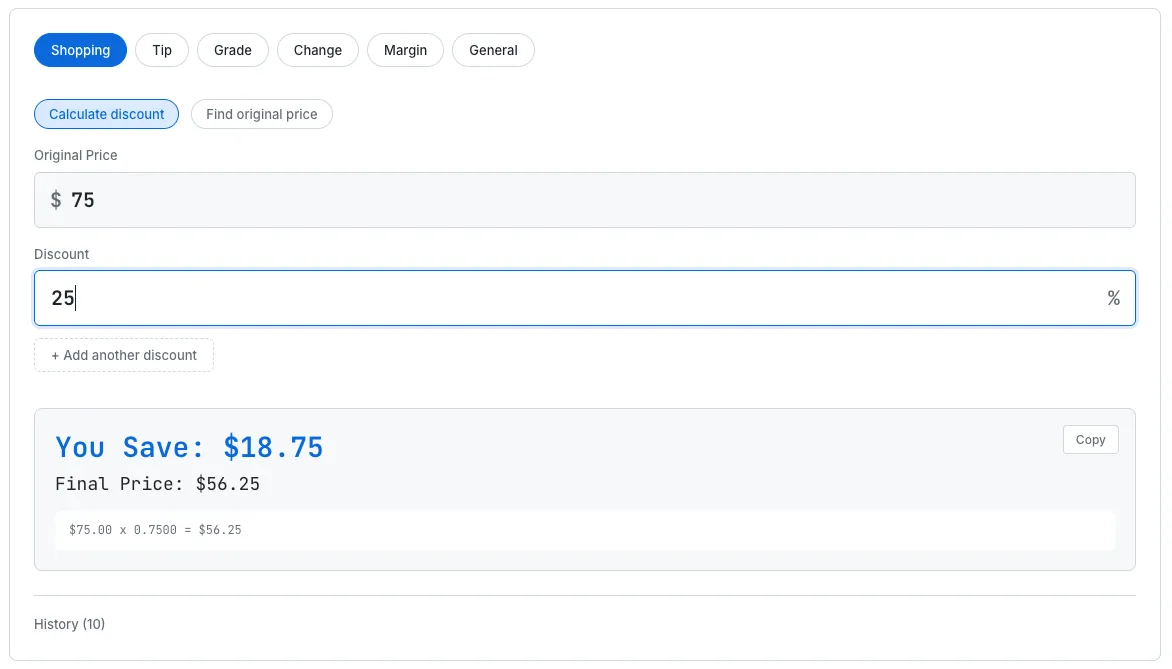
Shopping mode: enter the price and discount, see the savings and final price instantly.
SudoTool's Percentage Calculator is designed to prevent exactly the mistakes described above. It has dedicated modes for shopping discounts (including stacked discounts with step-by-step breakdowns), tip comparison, grade calculation, percentage change, and markup vs. margin side by side. When you enter stacked discounts, the tool automatically displays a warning: "30% + 20% = 50% off? No! It's actually 44% off." The Margin mode shows both markup and margin simultaneously so you can see the difference at a glance. All calculations run in your browser — no data is sent to any server.
Curious about how this tool was built? Read the story behind it: Why I Built a Percentage Calculator When Google Already Answers "20% of 150".
Frequently Asked Questions
What does "percent" mean?
It comes from the Latin "per centum," meaning "for every hundred." 25% means 25 out of 100. The concept dates back to the first century BCE, when Roman Emperor Augustus levied a 1% tax on auctioned goods.
Is 30% off plus 20% off the same as 50% off?
No. The actual discount is 44%. The second discount applies to the already-reduced price, not the original. Formula: effective discount = d1 + d2 − (d1 × d2) = 0.30 + 0.20 − 0.06 = 0.44.
What is the difference between markup and margin?
Both express profit as a percentage, but with different bases. Markup divides profit by cost; margin divides profit by selling price. A $30 profit on a $70 cost is a 42.9% markup but only a 30% margin. A 100% markup equals a 50% margin.
Why doesn't a 50% gain and 50% loss cancel out?
Because they operate on different bases. $100 + 50% = $150. $150 − 50% = $75. The loss is calculated on the larger number. The net result is always a loss of r² — for 50%, that's a 25% net loss. A 50% drop requires a 100% gain to recover.
What are percentage points?
The absolute difference between two percentages. If unemployment goes from 5% to 8%, that's a 3-percentage-point increase (absolute), but a 60% increase (relative). These are very different statements, and news headlines often confuse them.